

For those who are new to requesting that a notary public notarise a document for them, terms such as ‘apostille’, ‘consularise’ and ‘legalise’ can be unfamiliar and confusing. It’s therefore reasonable for a client to ask why these terms are relevant and why they might be required in their particular case.
Whether you need an apostille service or consular legalisation in London, understanding the difference can save you time and money when legalising UK documents for use abroad.
In this blog, we’ll explore these key terms and provide a useful guide for anyone requiring their documents to be apostilled and/or consularised for use in overseas countries.
The specific topics we’ll cover include:
- Understanding key terms: apostille, consularisation and legalisation
- When do I need an apostille for foreign documents vs embassy legalisation?
- How to get an apostille UK service: cost and timeline for legalising UK documents for abroad
- Which UK documents can be apostilled without notarisation?
- Apostille and legalisation services: What documents can we help with?
- When do I need an apostille for foreign documents? Country-by-country requirements
- The future of apostille UK services: the ‘E-Apostille’ explained.
Understanding key terms: apostille, consularisation and legalisation
The key difference between an apostille and embassy legalisation is that apostilles are accepted by treaty countries (the countries that have signed the Hague Apostille Convention, explained below), while embassy legalisation London services are required for non-treaty nations.
Apostillisation
The word ‘apostille’ derives from the French ‘to note’. Its prevalence is in relation to its inclusion within the Convention of 5 October 1961 Abolishing the Requirement of Legalisation for Foreign Public Documents (also known as the ‘Hague Apostille Convention’ or the ‘Hague Convention’).
This is an international treaty drafted by the Hague Conference on Private International Law, which currently has 129 contracting parties/countries.
The purpose of the Apostille Convention is to reduce the hitherto bureaucracy and costs in having any public document issued by Contracting Party A accorded recognition for use in Contracting Party B.
Parties to the Apostille Convention will simply require a public document issued in Contracting Party A to be apostilled (e.g. to be affixed with an apostille certificate issued by the competent authority(ies) of Contracting Party A) without further consularisation or legalisation by the diplomatic, embassy or consular presence of Contracting Party B in Contracting Party A.
This means that countries that aren’t a party to the Apostille Convention may insist that public documents issued in another country be both apostilled and consularised/legalised (and, very often, be notarised by a notary public before either of the foregoing steps).
Consularisation or Legalisation
Consularisation/legalisation is defined in Article 2 of the Apostille Convention as follows:
“Legalisation means only the formality by which the diplomatic or consular agents of the country in which the document has to be produced certify the authenticity of the signature, the capacity in which the person signing the document has acted and, where appropriate, the identity of the seal or stamp which it bears.”
In reality, this means that a document may be notarised, apostilled and – finally – consularised/legalised before it is accorded recognition for use in a country that isn’t a member of the Hague Apostille Convention.
A sample of the apostille certificate, mandated under the Apostille Convention, is as follows:
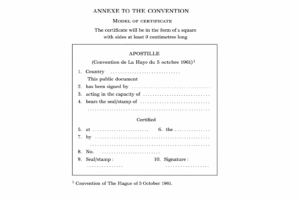
So, to answer the question, “When do I need an apostille for foreign documents vs embassy legalisation?” It depends on whether your destination country is party to the Hague Apostille Convention. Member countries accept apostilled documents without further legalisation, while non-member nations require the additional step of embassy or consular legalisation in London.
How to get an apostille UK Service: cost and timeline for legalising UK documents for abroad
For the purposes of this blog, we’ll only be focusing on the process for obtaining an apostille, consularisation or legalisation of a document in the United Kingdom.
Once a document, where required, has been notarised, it must be submitted to the respective UK authority empowered to issue apostilles. For present purposes, this is the United Kingdom Foreign, Commonwealth and Development Office (known as the ‘UK FCDO). The original notarised document must be submitted to the UK FCDO (either in person or by post) at the following address:
Foreign, Commonwealth and Development Office (FCDO)
Hanslope Park
Milton Keynes
England
MK19 7BH
Note that many clients in London use our document legalisation UK services to handle this entire process on their behalf.
FCDO apostille services
The UK FCDO offers the following apostille services:
- Urgent same-day apostille service: Only permitted in limited circumstances where there are strong reasons approved by the UK FCDO for the document to be apostilled on the same day. All requests must be made in writing by no later than 4:00pm on the previous working day to: UrgentLegalisation@fcdo.gov.uk (this service is only permitted by registered businesses, including many firms of notaries such as ourselves);
- Next-day apostille service: Completion of the apostille by the next working day (again, this service is only permitted for applicants who are registered businesses with the UK FCDO); and
- Standard apostille service: This service is open for applications by members of the general public, although the current estimated processing time is at least 15 working days.
The present fees for the above services (excluding courier/postal charges for the standard apostille service) are as follows:
| No | Service Type | Fees (£)* | Processing Timeline |
|---|---|---|---|
| 1 | Restricted Urgent Apostille Service | £100 | Same day (extreme emergencies only, rarely approved) |
| 2 | Next-Day Apostille Service | £40 | 1 working day |
| 3 | Standard Service | £45 | 3 – 5 working days (postal) |
Notes: Fees are per document. Fees are FCDO government charges; agent services add handling costs (£20+). An e-apostille (digital) alternative is £35, taking one or two days.
Should the notarised and/or apostilled document(s) need to be further consularised or legalised, then the specific process to be followed will depend on which embassy, diplomatic or consular body of the country based in the UK where the document will eventually be put to use requires.
This, of course, means consulting the specific website of that specific country’s embassy/consular presence, as each country has its own particular requirements.
It should be noted, however, that no embassy/consular presence of a country in the UK will accept a document that has been electronically notarised and/or electronically apostilled.
Which UK documents can be apostilled without notarisation?
Documents that emanate directly from a public institution of the UK may undergo apostillisation without being notarised first.
Examples include:
- UK court documents sealed with a wet-ink court seal;
- Public registry documents, such as a birth, marriage or death certificate, or a company certificate issued by Companies House (which must contain a wet-ink signature of the Registrar of Companies);
- Government department documents signed by an official, such as a letter of confirmation of tax registration; and
- Documents signed by a registered doctor, such as a medical certificate signed by a doctor (but note that some immigration authorities may request notarised medical reports to check your health status and eligibility for entry).
Many other documents must instead first be notarised by a notary public before they can be apostilled by the UK FCDO. This is especially for documents being used outside of the United Kingdom. Solicitors can, for example, certify documents, and these can then be apostilled, but they are mainly used in the UK.
Apostille and legalisation for birth and marriage certificates: Which UK documents need notarisation?
Public registry documents like birth and marriage certificates often require an apostille (for Hague Convention countries) or full legalisation (for non-Hague countries), but only if they bear a wet-ink signature from the issuing Registrar or an official certified copy from the General Register Office (GRO). Short-form extracts typically don’t qualify. Full, unabridged versions (e.g., on green paper for GRO) are needed, and religious marriage certificates require prior notarisation.
Apostille and legalisation services: What documents can we help with?
Our apostille and legalisation services cover the full range of UK documents requiring certification for use abroad. Common requests include apostillisation and legalisation for birth and marriage certificates, educational degrees, powers of attorney, and apostilles and consular legalisation for company documents such as certificates of incorporation, board resolutions and articles of association. Whether you need a simple UK apostille certificate or full embassy legalisation processing, we handle the entire chain from notarisation through to final consular approval.
When do I need an apostille for foreign documents? Country-by-country requirements
As we’ve stated, countries that are parties to the Hague Apostille convention will generally require that notarised documents are first apostilled by the authorised body of their jurisdiction before they can be used in another Apostille Convention Contracting State.
Having said that, for notarised documents emanating from the United Kingdom, certain countries (including, for example, British Territories overseas, crown dependencies and certain commonwealth countries, such as Australia, Canada, the Bahamas, Grenada, Trinidad and Tobago, and New Zealand, to name but a few) will instead accept documents that are simply notarised without the added step of apostillisation.
Other commonwealth countries do, however, on certain occasions accept notarised documents and – on other occasions – insist on documents being both notarised and apostilled. These include countries such as Bangladesh, India and Pakistan.
The future of apostille UK services: the ‘E-Apostille’ explained
The United Kingdom introduced the e-apostille service to the public in September 2022, following a pilot initiative that began on 15 December 2021.
However, as stated earlier in this blog, embassies and consulates won’t consularise or legalise an e-notarised and e-apostilled document.
It’s therefore imperative to ensure whether the e-notarisation and e-apostille process is the right one for you to follow for any specific case. You’re welcome to check with our firm in advance, as we have considerable experience in completing both paper-based and e-notarised and e-apostilled documents.
Conclusion
Members of the public faced with needing to notarise, apostille and/or legalise/consularise documents are often confused by the apparent multitude of processes involved.
For those who are unfamiliar with such processes, it’s strongly advisable to contact your nearest notary public who is specifically trained and experienced in handling all manner of documents.
For more information or a quote to assist with your notarial, apostille or consular/legalisation needs, please contact us at Notary.co.uk by emailing: info@notary.co.uk or calling 020 7630 1777 today.
FAQs
When do I need an apostille for foreign documents?
You need a UK apostille certificate when using documents in any of the 129 countries that are parties to the Hague Apostille Convention. For non-member countries, you’ll likely need both apostille and embassy legalisation.
What’s the difference between an apostille and embassy legalisation?
An apostille is sufficient for treaty countries, while embassy legalisation in London services involve additional certification by the foreign country’s diplomatic mission in the UK.
How long does apostille and consular legalisation take in the UK?
The standard apostille service takes at least 15 working days. Next-day service costs £40, and urgent same-day service costs £100. Embassy legalisation timelines vary by country.
Do company documents need an apostille and consular legalisation?
Yes, company documents from Companies House often need an apostille and legalisation for company documents used abroad, particularly for setting up overseas operations or business registrations.